Transforming intent into action
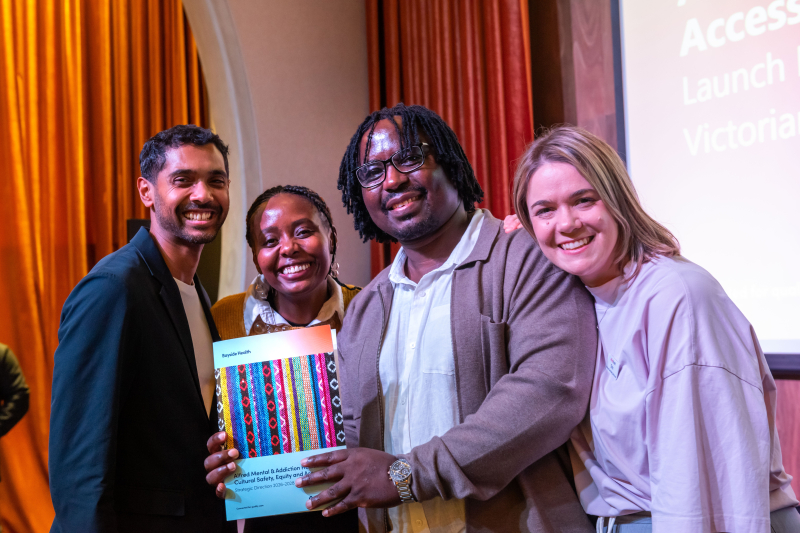
Alfred Mental and Addiction Health (AMAH) staff, including clinicians and lived/living experience workers, gathered at the Victorian Pride Centre to launch the new Cultural Safety Equity and Access (CSEA) Strategic Direction 2026-2028.
Grounded in cultural humility and developed in direct response to recommendations from the Royal Commission into Victoria’s Mental Health System, the Strategic Direction sets out a roadmap for embedding culturally responsive practices across leadership, governance, workforce development, community engagement and service delivery.
AMAH Senior Lead, Cultural Safety, Equity and Access, Erin Joyce said the strategy not only provides a clear pathway to achieving its outcomes, but also challenges common assumptions about how those outcomes should be delivered.
“There is a misconception that creating a culturally safe, equitable and accessible environment requires individuals to master knowledge of all cultures and lived experiences beyond their own,” Erin said.
“Our Strategic Direction makes clear that this expectation of cultural competence is both unrealistic and places unnecessary pressure on staff.
“Instead, our focus is on cultivating and embedding cultural humility across all roles and levels of our service.”
AMAH Cultural Safety, Equity and Access Advisor Taff Ruvaro said cultural humility positions healthcare workers as learners, rather than authorities on the care needs of consumers.
“Cultural humility is an approach that orients us as mental and addiction health workers to be curious and receptive to the experiences of consumers,” Taff said.
“It directs us to listen so that we can add to our understanding of their needs.
"It’s an incredibly powerful approach when you consider that trust, safety and connection underpin recovery.”
The AMAH CSEA Strategic Direction 2026-28 outlines four strategic pillars which provide direction for action, establish benchmarks for success, and create a framework for continuous progress.
“Each pillar has an overarching goal, broken into a set of clearly outlined objectives,” Erin said.
“Each objective details an accompanying rationale, measures of success, an accountable lead, strategic allies and expected outputs.”
Together, the pillars are designed to focus efforts, guide decision-making and ensure consistent progress is made across all areas of the Alfred Mental and Addiction Health system.
Speaking at the launch, Program Director A/Prof Simon Stafrace said AMAH’s continued efforts to best position itself to deliver equitable, inclusive and culturally responsive mental and addiction health services demonstrates its position as a system leader.
“Today matters, and this document matters, because we are naming the challenge clearly,” A/Prof Stafrace said.
“We're saying that cultural safety, equity and access are not peripheral concerns.
“They're not special projects and they're not the responsibility of a single committee, a portfolio or a passionate group of people.
“They are core business.”
Read the full AMAH CSEA Strategic Direction 2026-28 here.