Breakthroughs at the cutting edge of phage therapy
Findings from VICPhage’s first patient have been published in leading medical science journal Nature Medicine, advancing phage-based therapeutics worldwide.
A clinical partnership between The Alfred and Monash University, VICPhage is one of the first programs in Australia to offer end-to-end capacity in phage therapy to treat patients with severe infections that do not respond to traditional antibiotics.
Phage therapy involves injecting a patient with viruses called bacteriophages (or phages for short) to kill bacterial infections that have not responded to other treatments.
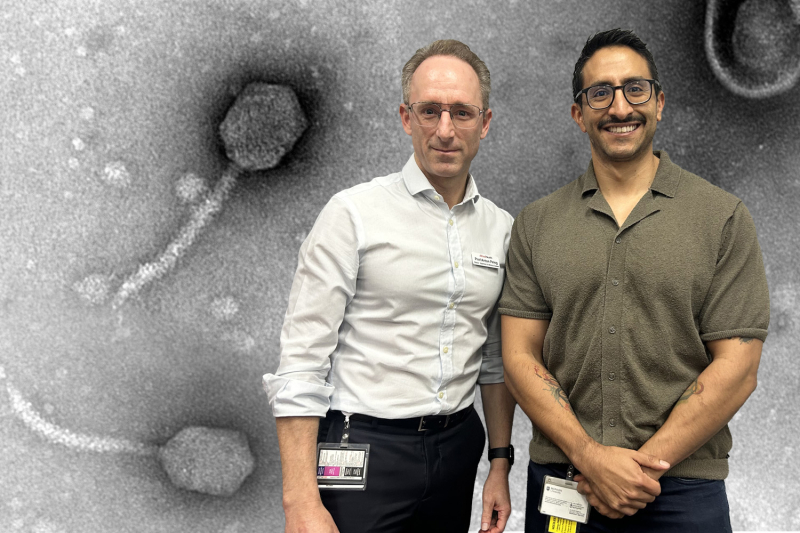
VICPhage Co-Lead, senior author of the paper and The Alfred’s Director of the Department of Infectious Diseases Professor Anton Peleg said the new findings have broad application across therapeutics, clinical trials and research.
“The evidence we gathered and published in Nature Medicine allows us to have a better understanding of what really goes on in the body of a patient when we treat them with phage therapy,” Prof Peleg said.
“By fully understanding the complex interactions between the patients immune system, the bacteria and the phage, we can better adapt phages to treat infections more effectively.”
Prior to administering phage therapy, Prof. Peleg is required to obtain Therapeutic Goods Administration (TGA) approval for compassionate use, which includes exhausting all traditional antibiotic treatment options, and that the infection poses a serious threat to life, limb or function.
The new paper published in Nature Medicine details VICPhage’s first patient case in 2022, also the first ever in Victoria.
The patient was a 22-year-old man with cystic fibrosis who had severe, recurrent infections with bacteria that had become resistant to almost all available antibiotics.
Dr Fernando Gordillo-Altamirano, a postdoctoral researcher in the VICPhage Laboratory in the Department of Infectious Diseases at The Alfred, and first author of the paper said the case provided two findings that will benefit future phage therapy patients.
“We discovered that phage therapy didn’t quite work in this patient because he had pre-existing antibodies against the phage,” Dr Gordillo-Altamirano said.
“These antibodies destroyed the phages before they could kill the infection.
“We were swiftly able to determine how to test subsequent patients to see if they already have antibodies against particular phages, in order to adapt our treatment.”
Dr Gordillo-Altamirano said the publication of findings like these, when the clinical outcome for the patient was not favourable, plays a crucial role in countering publication bias, a phenomenon present in medical research.
“Medicine advances when we deeply understand why some cases may not go according to plan, and we share that knowledge with our colleagues,” Dr Gordillo-Altamirano said.
Prof Peleg said the findings will help with the selection of optimised phages for treatment of future patients.
“We now recognise the importance of evaluating phages for their ability to withstand neutralising antibodies from the patients immune system,” Prof Peleg said.
“So if we identify several phages that are active against the target bacteria, we can then test them and select those that demonstrate the greatest resilience.”
As phage therapy advances to the next stage of research, Prof Peleg said the insights gained from the paper will help to inform future clinical trials.
“In terms of next steps, what’s required is a large randomised controlled trial to determine whether phages are efficacious or not, particularly against a placebo,” Prof Peleg said.
“The findings we published in Nature Medicine set us up well to do just that.”