Companioning for better health outcomes
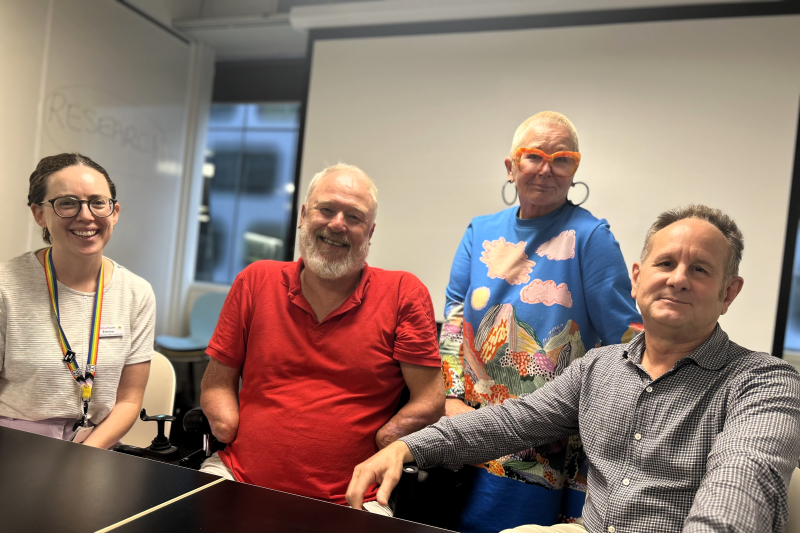
A partnership between The Alfred’s Hospital Admissions Risk Program (HARP) and charity Social Health Australia (SHA) is improving health outcomes by pairing patients with volunteer ‘companions’.
John Davey spent eight months in a hospital bed, having undergone a quadruple amputation after a battle with meningococcal disease and contracting septicaemia.
“I had many friends and family to support me, which was brilliant,” John said.
“But the reality is they can’t be there all the time, which meant I had quite a few moments of self-contemplation.”
That’s when John received a visit from Joe Sehee, a non-religious chaplain then working as part of The Alfred’s pastoral care team.
“He wasn’t trying to fix anything for me, and he didn’t claim to have all the answers,” John said.
“He simply listened.”
This experience became the blueprint for Social Health Australia, a volunteer run charity co-founded by the two men (John as Director and Joe as Executive Director), which pairs patients with companions.
“What we’re essentially providing is a form of subclinical, social, emotional and existential care,” Joe said.
“While clinicians take care of the immediate, crucial work of helping patients to heal physically, there is also a need for patients to know they are not alone in navigating instances of extreme difficulty.”
Nurse and Clinical Operation Lead at HARP Emma Jessup said her team works to identify patients who could benefit from being connected with SHA.
“The hospital can be quite a fast-paced environment compared to most people’s daily lives,” Emma said.
“While our clinicians are good at connecting with patients, it’s not the same as spending time with someone whose sole focus is to connect and listen.
“So when we identify patients who we think could benefit – perhaps we notice they haven’t had many visitors, or they mention they don’t have a lot of family to lean on – we can pop in a referral to Social Health Australia with their consent.”
Emma said the HARP team frequently observe the positive effects of the service extending beyond a patient’s personal wellbeing.
“We’ve noticed vast improvements in the way they're able to understand their health concerns and engage with us as a health service,” Emma said.
"The companionship creates a bridge from the hospital to their life at home, and empowers them to link with other primary health networks like GPs and other services in their community.”